Monday, October 16, 2017

Reflections on Half a Year in Munich

I find it hard to believe we’ve already been living in Munich for six months! 

In some ways it feels like we’ve always been here, and in others it’s like we stepped off the train yesterday.

Our too-brief time in Hamburg taught me to take full advantage of the opportunities offered around me. 

So I thought I’d share some stats and, of course, some pictures from my first six months in Bavaria.

Since moving here in April, I have:

Done a Munich walking tour (twice) and a biking tour

Here I am with my good friends Amanda and Anne on a recent biking tour. If I can find a good cruiser seat for Betty like the one I had on the tour, I might get more into this biking thing!


Visited 13 Munich museums or special exhibits

My favorite museum to date is the Glyptothek--a collection of ancient statuary


The Toy Museum gets a nod
for its creepy display
of disassembled teddy bears


A cool statue in the Bavarian National Museum.
That's right, she's made of WOOD


The coolest non-museum display
I've seen was The Art of the
Street exhibit. Graffiti/street artists
showing off their incredible talent!


The Egyptian Art Museum gets the creativity prize for using hieroglyphs to explain the museum rules.


Visited 13 other Munich sightseeing attractions (including Dachau)

Blutenberg Palace, complete with small moat, was hosting an art exhibit and a wine festival the day I visited

The lovely Botanical Gardens are next door to my favorite Munich attraction, the Nymphenburg Palace.


Visited the 3 remaining city gates, 4 aesthetically exceptional churches, and 4 craft or folk fairs in Munich


Asamkirche is not very large, but makes up for its size by its extravagance.


In May we attended Munich's first-ever Craft Beer Festival.
(I'll write more about German beer and its purity laws in a future post.)

Been to the top of two different towers for panoramic city views

The view from the Olympic Tower is nice...
...but I've climbed the tower of St. Peter's Church three times, and the view over the older part of Munich is even nicer.
On my latest climb, the late-afternoon/early-evening  haze cleared for a great view of the Alps!


Experienced Oktoberfest

The first time I saw this car, we were on our way to Oktoberfest. My first thought was "oh, security back-up."
Then I did a double-take.


Hiked in the Bavarian Alps

A statue outside the Alpine Museum in Munich
(haven't visited this museum yet)


Hosted my family and five best friends from college

On Marienbruecke just outside
Neuschwanstein Castle, 1976


On Marienbruecke just outside
Neuschwanstein Castle, 2017


It's nearly impossible to get pictures of my dad, so we were happy that BMW World gave us ample opportunities

Family selfie!


And here we are in downtown Munich
for our (on average) biennial reunion

I could do a whole separate blog
about the L-Mates and our
28-year friendship! Here we are
as college freshman in our dorm lobby
on Valentine's Day in 1990

Visited 14 other cities (including Landshut and Hanau)

Ulm is Albert Einstein's birthplace,
and home to the world's tallest church steeple.


So naturally I climbed it!


During my family's stay, we went to Berchestgaden and visited a Nazi bunker and Hitler's Eagle's Nest

Visited 4 other countries


You can check out pictures from my May trip to Venice in this post.

You can check out pictures from my July vacation in Malta in this post.


Like Malta, the primary purpose of our September getaway to Mallorca was the beach, but on a day when the weather turned unfriendly, we ditched the sand and visited some nearby prehistoric caves.


With my family I hit three different cities in Austria:
Innsbruck (famous golden roof shown here)...

...the nearby town of Wattens, where we visited
the Swarovski Crystal World...


...and Salzburg, where we explored the town a little before heading up to explore the fortress.


My local bucket list is much shorter now, but my vision is long. I’m looking forward to the next six months of adventures!


Tuesday, October 3, 2017

Oktoberfest


Well, I had to interrupt my brief break between visitors and do a post, because today is the last day of Oktoberfest 2017. 
My favorite mobile
game got in the spirit
with their most
recent theme.

It’s also a holiday—German Unity Day—which means everything’s closed except for restaurants and some attractions (like Oktoberfest!).

Although Munich has been celebrating the marriage of Prince Ludwig and Princess Therese von Sachsen-Hildburghausen for the past 207 years, this was my first time experiencing the event.

So here are a few pictures from our Oktoberfest expedition during my family’s recent visit. 

First impression? Oktoberfest is a lot different than I expected—very family-friendly, like the world’s largest beer-drinking carnival.

Just as important as beer is the food.
Ox is traditional, wurst is everywhere,
but most places serve you a 1/2 chicken along with your beer.

We went on the day the Bavarian bands gave a traditional concert at the base of the Bavaria statue. The brass bands were great, and there were also some singing and dancing performances. 


But what we were really waiting for 
were the Alpine horns. Awesome!

Afterwards, all of the bands marched through the fair grounds.


Many of the halls had their beer wagons and horse teams out on display.

Just because the event caters a lot to families doesn’t mean that we didn't see plenty of public drunkenness, a bit of public urination, elbow-to-elbow crowds, and a police report of a couple leaving their baby behind at the grounds.

My parents at Oktoberfest in 1978.
Back then, the focus was
beer tents and Bratwurst.
My parents at Oktoberfest in 2017.
They were amazed at the difference
in atmosphere.
Oktoberfest etiquette: don't grab the handle,
and don't call it a Stein of beer. It's a Maβ.


Now I understand why folks might go back for multiple days over the three-week run.

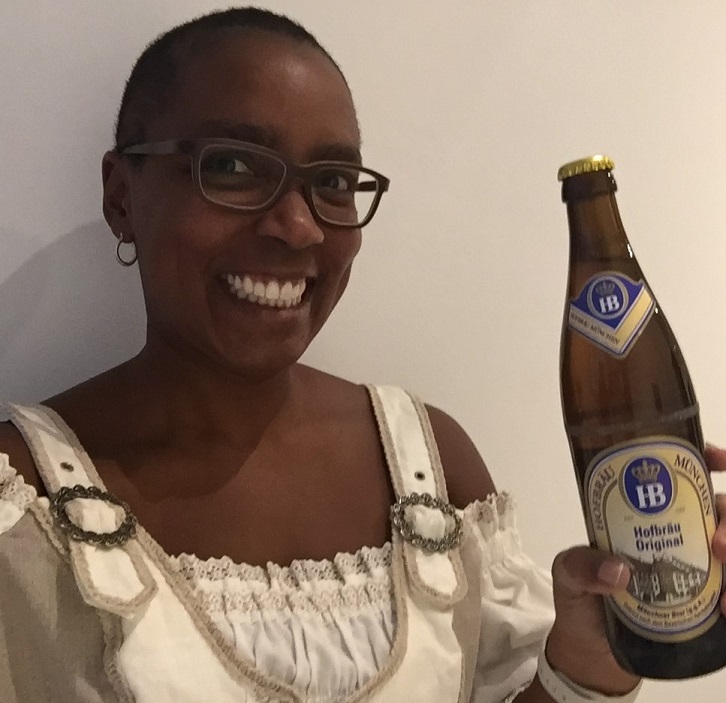
I’m looking forward to multiple visits myself next year, by which time I might have broken down and gotten myself a Dirndl. 😊

Prost! 


Wednesday, September 20, 2017

Eine kleine Pause

Well, it's that time of year.


Yes, Oktoberfest has started, but I meant the crazy period when everyone decides to come visit around the same time (although come to think of it, Oktoberfest might have a big hand in that this year...).

With family arriving in mere hours for a two-week stay, and my college besties following close on their heels, I'm going to be taking a small break from blogging to play hostess and tour guide.

I'm looking forward to sharing all the fun with you once I'm back. In the meantime, since I don't have an anecdote on hand, I'll have to share some trivia. Check out this list of everyday things invented by Germans.

See you in mid-October!


Tuesday, September 12, 2017

Democracy in Deutschland: The 2017 German Election

It could be argued that the reason only 58% of Americans voted in last year's election was they were weary of all the politicking by the time the election rolled around. Our campaigns have become an industry, and much like the annoying retail creep of Christmas, they keep moving further from the actual event.


By contrast, turnout for Germany's last election was around 70% (which was lamented at the time for being rather low). But Germans aren't beating voters over the head and wearing them down with trivialities, like in the U.S. 

This year's election in Germany is on September 24. Posters for local candidates only started appearing around Munich a few weeks ago. 

I followed a live feed on Twitter during the debate between majority party candidates Angela Merkel and Martin Schulz, which seemed to be more of a casual discussion than the scorpion-sting sessions we witness in U.S. debates.

In fact, it’s illegal to disparage another candidate in election ads in Germany, so everything proceeds without the distraction of personal attacks.

During our election last year, I whined a bit about the booklet California sends to voters. Pros, cons, and costs for each of the 20+ ballot measures, and local candidate bios. It’s like studying for a test.

A friend from Spain wished for something so detailed. With more than 20 political parties participating in their elections, she said the choice usually came down to which parties were not yet known to be corrupt.

Germany may not have corruption to contend with, but it does have more than 40 parties from which to choose, including a new hip-hop party. Only a handful are considered the “main” parties that will decide the face of the government.

Technically, the U.S. also has more choices. Most ballots contain candidates from at least five political parties, but with the majority of our history dominated by just two, it’s easy to gloss over. And while Germany’s legislature is made up of a mix of its parties, the U.S. currently boasts only two senators whose affiliation is neither Democrat nor Republican.

A few weeks ago, CNN did a great breakdown of how the German political machine works. Although the concept of achieving maximum representation is the same, I find it to be much less confusing than our electoral college behemoth.

Image from TeamLiquid.net
Like the U.S., there are regional differences in voting here, and I think many of those tendencies align with the stereotypes Germans hold about each other: northerners have a reserved demeanor but are liberal, southerners are insular and conservative, North Rhinelanders are outgoing but maybe superficial, Saxons are proud of their exploring/plundering heritage, etc.

Unlike the U.S., the autonomy of the 16 German states is broader--it's the legacy of a country comprising former fiefdoms and kingdoms.

Before learning about the two-vote system, I asked a German friend if it was likely someone like Trump could be voted into office here. He said Germany learned its lesson. People vote for parties and what they stand for; it’s not like the cult of personality we’ve come to celebrate in American elections.

Trump is the perfect example of this. He is by no means the best representative for the Republican platform, but he had a surprising avalanche of support that forced the Republicans to take a chance and bet on him as their best shot of taking control of the government.

The only real surprise is that people are surprised Trump is so unpredictable. As he tramples roughshod over the American democratic ideal, leaving even our allies shaken in his wake, Germans have had no qualms about showing their distaste for him and what he stands for.


Yet despite their assertions of practical decision-making at voting time, there is an obvious affection among many Germans for Angela Merkel. Her nickname, “Mutti,” is a diminutive of Mother. 

Merkel is the antithesis of Trump and other so-called populist leaders. Her measured approach seems to look five steps down the road to meet divergent interests rather than self-serving, short-term tactics. 

The biggest challenge to her leadership has been the issue of immigrants, which, at its height, propelled Germany’s version of an alt-right party into unprecedented popularity. 

But that seems to have died down, and the top two parties agree on another social stickler: lowering taxes for the middle class and possibly eliminating surcharges levied since reunification to rebuild the former East Germany.

Although there’s a time to shake things up, and proceed with informed and thoughtful change, the proponents of a new world order have not brought that to the table to date. 

Divisiveness, posturing, and inflammatory rhetoric is not what we need in the face of continued refugees of war and terrorism, newly nuclear-capable nations, and the increasing impacts of climate change.

Germany is Europe’s strongest economy, with a record low unemployment rate. There are few things to rail against, so in all likelihood voters will choose to stick with stability.

These days, "tried and true" seems to be the new political revolution.


Tuesday, September 5, 2017

Munich’s Olympic Legacy

First time an Olympic mascot
was named: meet
Waldi the dachshund
From August 26 to September 11, 1972, the XX Olympic Games were held in Munich. These summer games were destined to be a series of firsts:

  • First time a swimmer won 7 gold medals in a single Olympics (Mark Spitz, U.S.)
  • First time slalom canoeing appeared
  • First time an Olympic wrestler won a gold medal without having a point scored against him (Dan Gable, U.S.)
  • First time the U.S. basketball team lost a game in Olympic competition
  • First time a swimmer won medals in five individual events in a single Olympics (Shane Elizabeth Gould, Australia)
  • Largest games up to that point, with 195 events and 7,134 athletes


The groundbreaking stadium design was the first time metal ropes were used on such a scale

Unfortunately, the games are remembered largely because they were the first time that terrorism took the stage and held the attention of the world.

Trying to Escape the Past


Germany was under a lot of pressure for the 1972 Summer Games. The only other time the Olympics were held in Germany was during the Nazi regime.

During their stay, the Israeli Olympic team visited the Dachau Concentration Camp Memorial site just outside of Munich; a painful reminder of Germany’s not-so-distant past, and an impetus for Germany to show the world its path forward.

But Germany was itself a country divided into East and West, trying to uphold the ideals of global sportsmanship and friendly competition. And the theme it chose, “The Cheerful Games,” hit a small speed bump right at the start.

Security measures at Munich airport meant some commercial flights were diverted to Fürstenfeldbruck, an air force base approximately 30 km from Munich. Passengers encountered armed escorts to and through the terminal. To try and minimize this first impression of the games, a military brass band played as travelers came through.

September 5, 1972

Five days before the closing ceremony, members of Black September, a faction of the Palestinian Liberation Organization, launched a pre-dawn attack. They invaded an apartment of Israeli athletes, coaches, and officials in the Olympic Village and took them hostage. Their demand? The release of more than 200 political prisoners.

The terror began immediately. While a few hostages escaped through a window, a wrestling coach attacked the intruders and was shot and killed. A weightlifter also fought back, and was killed and castrated. Nine hostages remained.
Picture of one of the Black September terrorists
on the apartment balcony at Connollystrasse 31
photo (c) AP/Kurt Strumpf

Most of the day was spent trying to appeal to the kidnappers and offer ransom (which was refused). Subsequent evidence indicates the hostages were beaten and tortured during their capture.

Approximately 12 hours into the siege, German officials launched “Operation Sunshine,” an attempt to scale and infiltrate the building and rescue the hostages. Unfortunately, everything was being broadcast in real-time on TV, giving the terrorists fair warning.

That evening, weary of missed deadlines and fruitless negotiations, the terrorists demanded transportation to Cairo. The hostages and their captors were transferred by helicopter to Fürstenfeldbruck, where German law enforcement had laid a trap. The plan went horribly awry as the terrorists uncovered pieces of the planned ambush, and a gunfight ensued.

Four hostages in one helicopter were shot and then incinerated by a grenade. The remaining five hostages, five of the eight terrorists, and one German police office were also killed.

Aftermath: Operation Wrath of God


The three surviving terrorists were imprisoned to await trial. But they were released only weeks later on October 29, after Black September hijacked a Lufthansa flight. All were granted asylum in Libya.

Two of the three surviving terrorists were later tracked down and executed by Israeli special forces. In addition, members of the network responsible for planning the attack were killed. As of 1999, one terrorist was still alive and in hiding somewhere in northern Africa.

Aftermath: Who, What, When, & How


Following the tragedy, the Olympic Games were suspended for 24 hours, then resumed after a short memorial ceremony. By then, criticism of the handling of the crisis had begun, and investigations into the specifics continued for decades.


  • Germany had no anti-terrorism unit, and a post-war prohibition on using the military during times of peace meant no combat-ready personnel were participating in rescue attempts.
  • The “snipers” stationed at the airport were weekend marksmen who were trained to incapacitate rather than kill. They had inadequate guns for the distance and lighting, minimal protective gear, and no radios for updates about the number of terrorists or decisions to abort the original plan.
  • Families of the victims were compensated soon after the killings, but for 20 years authorities denied the existence of any documentation that could be used in negligence lawsuits. The German government finally released approximately 4,000 files, but when the families brought suits, a judge ruled that the statute of limitations had long passed. After a series of appeals, the cases were settled out of court in 2003.
  • Perhaps the worst indictment was that officials ignored the advice of experts. Not just on the day of the event, but well in advance. Three weeks before the games, officials reportedly received a tip that Palestine was planning an incident in Munich during the games. And Olympic organizers commissioned a forensic psychologist  to forecast likely scenarios to aid in security planning. His “Situation 21” matched the events of September 5, but security precautions had been minimized everywhere in order to uphold the "cheerful" theme of the games.

Stuck between a rock and a hard place, Germany’s efforts to erase the stigma of their previous Olympic hosting only ended in more Jewish bloodshed.   
  

Aftermath: Munich Massacre Legacy


Unlike many Olympic venues, the Munich park and athletes’ village were not disassembled or abandoned. The sports facilities are used as part of a large public park, and the village has become a residential area with some student housing.

Munich lost a bid to host the 2018 winter games, and some people balked at the thought they were trying to redeem their image for the 1972 games. But the city has not tried to sweep those events under the rug.

Just outside the subway station for the Olympic complex is a panel explaining the sad history of the Munich games. There is a memorial plaque on the building where the hostages were held, an installation on the walkway between the village and the stadium, and a memorial area just outside the village will officially open tomorrow during a commemorative ceremony.

The memorial plaque at the residence reads, "In this building lived the team of the state of Israel during the 20th Olympic Summer Games from August 21 through September 5, 1972.  On September 5, 1972, David Berger, Seew Friedman, Josef Gutfreund, Elieser Halfin, Josef Romano, Amizur Shapira, Kehat Shorr, Mark Slavin, Andre Spitzer, Jaakow Springer, and Mosche Weinberger died a violent death. Honor to their memory."


A documentary and several movies have been made about the incident, but aside from a couple of recent gestures, the International Olympic Committee had deemed it too political to acknowledge the tragedy in an ongoing way during subsequent Olympic Games.

So aside from the power of real-time television broadcasting, what lessons have we learned in the intervening 45 years?

Well, security at Olympic Games has been heightened significantly, and many more countries, including Germany, now have specialized anti-terrorism units. But have we decided that these kinds of incidents are just the way things now work? 

Kidnappings and murders in Mexico, South America, Africa, and wherever the Islamic State is able to strike, have become commonplace. What was once a tool of intimidation now seems to hit only a minor chord of detached horror before we move on to the next terrorist act.

My one hope is that we realize the world is shrinking and, though it may not seem like it, these tragedies affect us all. It is human nature to reach out to those who are hurting and in need, but it is also instinct to protect ourselves and the ones we love most, at all costs.

In the face of what seems to be unrelenting disappointment and devastation around the globe, we need to be vigilant. We need to continue to care. Although it goes against logic, this is not the time to insulate ourselves. When we withdraw from the world around us, we weaken ourselves in our ignorance and isolation. 

That's when small ideas become overblown and unchallenged. That's when fervor overrules facts. That's when we allow extremists on all sides to dictate the future or the destruction of the world we know.